El sacrificio a Inguma
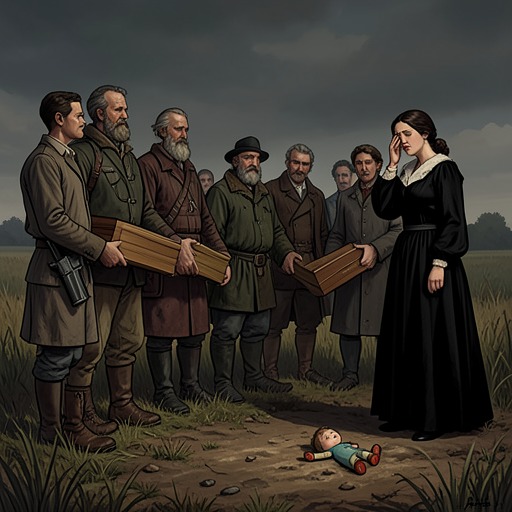
Ofrenda a la tormentaEl sacrificio a Inguma is the secret group’s prescribed form of human offering, a set of rules that makes a child’s age, baptism, sex, death, and body part of a single ritual transaction. The novel presents these requirements as the group’s beliefs and a witness’s account, not as proof that the supernatural powers invoked by the group exist. In the group’s own logic, however, the rules are exact: the child must be an unbaptized girl younger than two, killed by suffocation in imitation of Inguma, and the body must then be surrendered for the offering to be complete.
Doctrinal basis and purpose
The group’s rationale begins with a distinction between ordinary prayer and the offering of life. Its leader taught members that they could invoke ancient forces and put them to their service without prayers, a life of deprivation, or restrictions on their desires. According to the witness, the rites began with domestic animals and were believed to produce striking results; the human sacrifice represented the most consequential offering, reserved for a major favor.
The doctrine drew authority from a claimed return to tradition, respect for origins, and older local beliefs. The group invoked extraordinary magical presences associated with the region and claimed that early inhabitants had marked spiritually significant routes through megaliths and ley lines. These lines, in its account, linked monuments, mountains, cliffs, rocks, caves, and natural fissures—places where communication with spiritual forces might be easier. Such claims gave the group a geography and an imagined history for its rites; they explain the members’ framework, not an independently verified supernatural mechanism.
Within that framework, the offering was imagined as a transfer to evil. The child was considered especially desirable because the group regarded the child’s life as pure and the child as belonging, in a special sense, to the parents who had brought the child into the world. The parents’ act of surrendering their own newborn was therefore central to the rite: in the group’s theology, the demon would consume the child’s life and repay the parents with whatever favor they sought.
Eligibility and ritual procedure
Age was not incidental. The group treated the period from birth until the second birthday as a transitional stage in which the soul remained between two worlds. In a broader explanation offered during the investigation, Jonan Etxaide described a belief found in many cultures that children at this age could see and hear what occurred in both worlds, making them suitable intermediaries with spirits. The witness applied a similar idea to the group’s offering: a child’s soul was still in transition and therefore more useful to the forces invoked. After infancy, children remained desirable to the group throughout childhood, but the onset of adulthood was understood as another transition; the witness also noted that a death before the age of two could be easier to explain than the death of an adolescent.
The required victim was a girl and had to be unbaptized. The witness could not explain the group’s preference for girls, but said its leader had taught that sacrifices had to be made in same-sex groups. Inguma was said to take a number of victims of one sex and one age group, under identical circumstances, until a cycle was complete. Baptism disqualified a child because the group understood it as an offering and commitment to another god. The rule thus made religious status part of the selection process, alongside sex and age.
Death was to imitate the way the group believed Inguma took its victims: by depriving them of air. The witness described the killing as an obligation of the parents and said the body then had to be ceded and taken to an unknown place where it would fulfill its ritual function. He did not know where that place was, nor could he confirm whether the body of the girl from Lesaka had been handled in that way. The distinction matters: the account establishes the group’s prescribed procedure, while leaving the fate of that particular body unresolved.
Exchange, family pressure, and the cost of the rule
The expected return varied with the nature of the offering. The witness listed health, money, wealth, the removal of competitors, harm to other people, and revenge among the possible rewards; in exchange for the human sacrifice, he said, almost anything could be obtained. A later account of the group’s teaching added that economic wealth was the principal benefit shared among participants, while parents could receive whatever they wished. The offering therefore promised both a collective material gain and a private, potentially limitless return.
The group’s rules also shaped what happened to parents after the killing. According to the witness, men were generally the most committed members. Some women who had agreed to the rite fell into severe depression afterward, and the group’s instruction was to have another child quickly. The witness, speaking from the experience of losing a child, said he could not imagine loving a replacement child and might resent one if forced into that role. He also knew of women who had not been told what their husbands intended, and of cases that ended very badly. The doctrine of replacement thus appears not as a neutral consequence but as a coercive expectation laid over grief, secrecy, and unequal participation.
Use in the investigation and relation to other crimes
The witness’s account gave Amaia Salazar a way to interpret patterns across suspected infant deaths. It suggested why investigators should consider the parents’ relationships to one another: some couples might have separated after a sacrifice, and a child might have been buried in the mother’s family tomb. That possibility informed a practical investigative strategy. If a mother requested an examination, the police might be able to seek access to a family tomb without a judicial order, and investigators were asked to identify parents of possible victims who were divorced.
The age rule also resonated with Amaia Salazar’s review of the Basajaun case. She recalled the witness’s explanation that a child under two was considered to remain between worlds, then compared the group’s language of purity and transition with the ritualized presentation of the murdered girls. In those crimes, the killer suffocated the victims with a thin cord, carried their bodies to the Baztán River, exposed them, shaved their pubic hair, arranged their hair in two halves, and placed their hands palms up. Amaia interpreted the gestures as a symbolic return to childhood and innocence. This resemblance strengthened the investigative connection between the cult’s ideas and the crimes’ imagery, but does not make every detail of the two practices identical: the cult’s prescribed infant offering included the subsequent removal of the body to a place the witness could not identify, whereas the girls’ bodies were left beside the river.
The rule’s narrative force lies in the way it converts vulnerability into eligibility. An infant’s liminal age, lack of baptism, sex, and dependence on parents are not incidental circumstances in the group’s scheme; they are the very conditions that supposedly make the child valuable. By setting those conditions against the promised rewards, the novel exposes a system in which ritual language disguises the deliberate killing of children and turns parental authority into an instrument of the group.